
Efficacy
Delivered
Hypothetical patient.

Phase 3 Study Design:
The efficacy of QIVIGY® was evaluated in an open-label, prospective clinical study in adult patients with primary humoral immunodeficiency. A total of 47 patients received intravenous infusions of QIVIGY at a dose of 266 mg/kg to 826 mg/kg on a 4-week (n=39) or a 3-week (n=8) infusion cycle for 12 months. There are no comparative head-to-head trials with QIVIGY.1,2
Primary Efficacy Outcome


Secondary Efficacy Outcomes
Secondary efficacy outcomes included patients hospitalized due to infection, number and duration of antibiotic treatment for any kind of infection, the incidence rate of infections other than acute SBIs, and missed work/school/other major activities due to infections.1


 Median of6 Days Lostfrom work/school due to infection1†
Exploratory Efficacy Outcome
 93%of patients were satisfied with QIVIGYvs 68% who were satisfied with their previous IVIG therapy2‡
*The median (min, max) duration of antibiotic treatment of any kind of infection was 10 days (1, 334). A total of 36 (76.6%) patients used at least 1 course of concomitant antibiotic therapy for treatment of infections. Eleven patients (23.4%) did not require antibiotic treatment.2
†The range of missed days from work/school due to infection was 1–53 days.1
‡A study-specific patient satisfaction questionnaire was an exploratory endpoint in the trial and collected from all 47 treated patients at Week 24.2
IVIG, intravenous immune globulin.
Protection Maintained
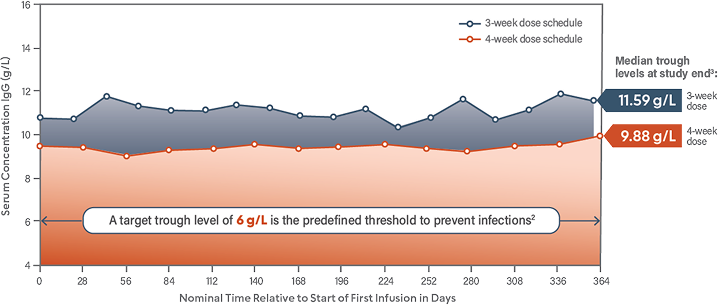
Steady IgG trough levels provided sustained protection throughout the dosing interval with QIVIGY2
Median total IgG concentrations2
Median total IgG concentrations2
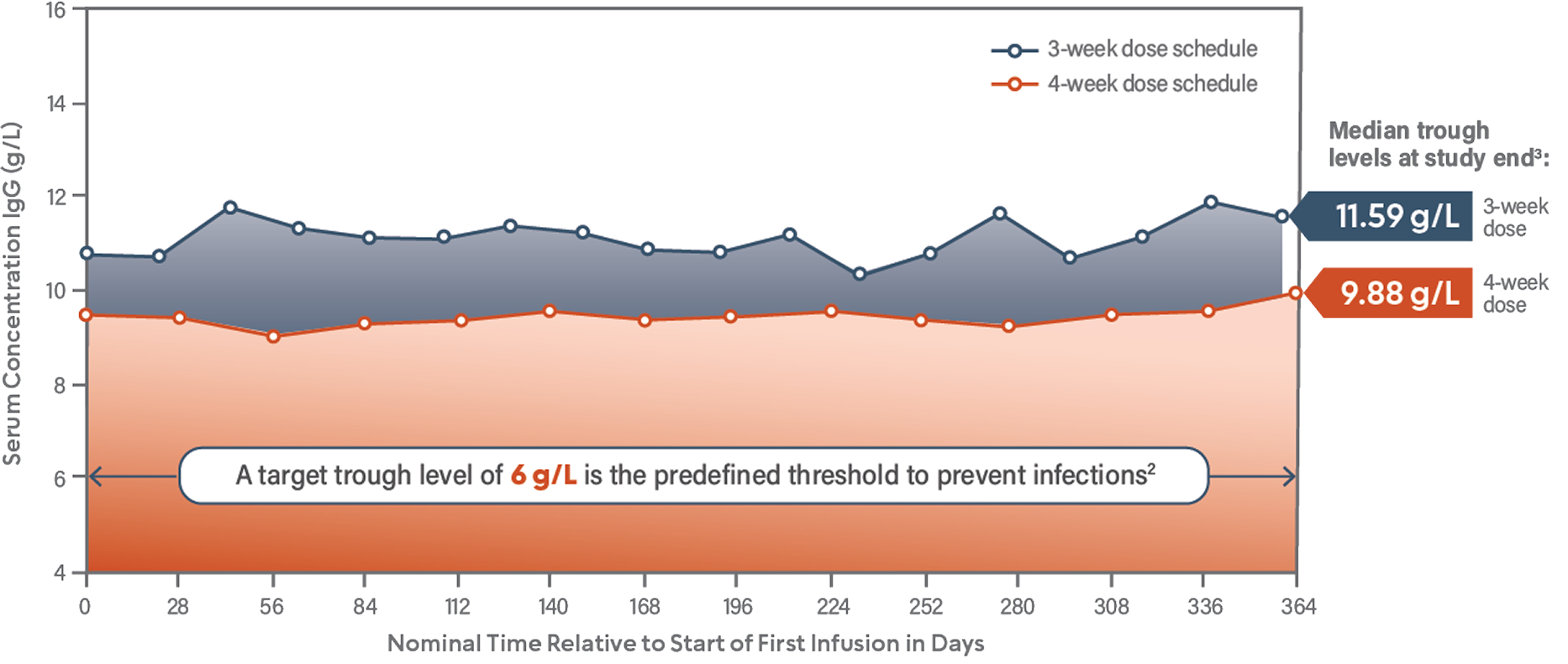
- IgG trough levels had minimal fluctuations across both the 3- and 4-week dosing schedules through study end2
- IgG trough levels remained consistently above 6 g/L, the threshold to prevent infections, except for in 1 patient at a single visit2*
*One patient with a history of chronic bronchitis and an exacerbation during the study had an IgG trough level of 5.63 g/L at Visit 7.2,4
IgG, immune globulin G.
QIVIGY demonstrated infusion tolerability and an uncompromising safety profile2
Most common adverse reactions* associated with QIVIGY infusions (ninf=643) in ≥5% of patients (n=47)1
| Adverse Reaction (AR) | Infusions % (n) |
|---|---|
| Headache | 4% (26) |
| Fatigue | 2% (10) |
| Coombs Direct Test Positive† | 1% (8) |
| Infusion-related Reaction | 1% (7) |
| Nausea | <1% (6) |
| Diarrhea | <1% (4) |
| Sinusitis | <1% (3) |
| Dizziness | <1% (3) |
*ARs were defined as AEs occurring during or within 72 hours of infusion or any causally related event occurring within the study period.1
†Positive Coombs direct test indicates the presence of antibodies on red blood cells which may be a sign of hemolytic anemia. A positive result alone does not confirm the diagnosis of hemolytic anemia. In the clinical trial, positive Coombs direct test results were detected in 36% of the enrolled population. Abnormal results assessed as clinically significant were reported as AEs, but no safety signal or trend was observed. No hemolysis events were reported, and no laboratory findings suggestive of hemolysis associated with positive Coombs tests, including hemoglobin decrease, were recorded during the trial.2,4,5
AE, adverse event.