
Infusions
Optimized
Hypothetical patient.

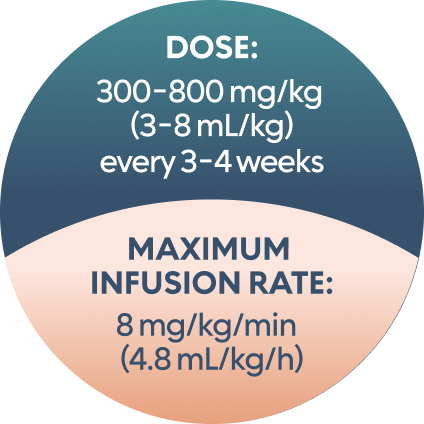
Recommended dosage1
For intravenous use only.
First Infusion
1 mg/kg/min (0.01 mL/kg/min) for 30 minutes; increase every 30 minutes to a maximum of 8 mg/kg/min (0.08 mL/kg/min) as tolerated
Subsequent Infusions
2 mg/kg/min (0.02 mL/kg/min) for 15 minutes; increase every 15 minutes to a maximum of 8 mg/kg/min (0.08 mL/kg/min) as tolerated
Maximize quality time with efficient infusions

97%Of infusions completed without rate reduction, interruption, or discontinuation[n=623/643]1,2
94%Of patients achieved the maximum infusion rate[n=44/47]2

15 minRate escalation schedule after first infusion1
- 6 patients on the 4-week dosing schedule (n=39) experienced an infusion rate reduction due to an adverse event3*
- The number of infusions for which 1 or more infusional adverse events have been reported is 80 out of 643 (12.4%). In 9 infusions, the infusion rate was decreased due to adverse events2
*Headache, pruritus, nausea, infusion site reactions, fatigue, and muscle tightness.3
Quality Established
QIVIGY® is:
 Glycine-stabilized and does not contain any sugars or preservatives1
 A high-purity (≥96% IgG) IVIG that contains trace amounts of IgA (≤50 mg/L)1
 Supplied in 5- and 10-gram single-dose vials1
 Manufactured with 4 steps of viral removal/inactivation1
National Drug Codes (NDC) for QIVIGY1
| Presentation | NDC Number of Carton | NDC Number of Label |
|---|---|---|
| 50 mL vial containing 5 grams of protein | 76179-010-01 | 76179-010-02 |
| 100 mL vial containing 10 grams of protein | 76179-010-03 | 76179-010-04 |
IgA, immune globulin A; IgG, immune globulin G.
Dosing Calculator
- In the pivotal trial, QIVIGY was studied using a 30-minute infusion rate escalation protocol for the first infusion and a 15-minute infusion rate escalation protocol for subsequent infusions.1
- Infusion rates should be increased only if the infusion is well tolerated.1
Rate Escalation Protocol: First Infusion
| Elapsed Time (min) | QIVIGY Infusion Rate | |
|---|---|---|
| mL/kg/ min | mg/kg/ min | |
| 0-29 | 0.01 | 1.0 |
| 30-59 | 0.02 | 2.0 |
| 60-89 | 0.04 | 4.0 |
| 90-119 | 0.06 | 6.0 |
| 120+ (maximum infusion rate) | 0.08 | 8.0 |
Rate Escalation Protocol: Subsequent Infusions
| Elapsed Time (min) | QIVIGY Infusion Rate | |
|---|---|---|
| mL/kg/ min | mg/kg/ min | |
| 0-14 | 0.02 | 2.0 |
| 15-29 | 0.04 | 4.0 |
| 30-44 | 0.06 | 6.0 |
| 45+ (maximum infusion rate) | 0.08 | 8.0 |
Infusion Considerations1
- Hydrate the patient adequately prior to the initiation of infusion.
- Monitor patient vital signs throughout the infusion.
- The rate of infusion can be related to certain severe adverse drug reactions. Slow or stop infusion if adverse reactions occur.
- If symptoms subside promptly, resume infusion at a lower rate as tolerated by the patient.
- The observation time of patients after QIVIGY administration may vary. If the patient (a) has not received QIVIGY or another IgG product, (b) is switched from an alternative IGIV product or (c) has had a long interval since the previous infusion, prolong the observation time for adverse reactions after QIVIGY infusion.
- Ensure that patients with pre-existing renal insufficiency are not volume depleted. For patients at risk of renal dysfunction or thrombosis, administer QIVIGY at the minimum dose and infusion rate practicable and discontinue QIVIGY if renal function deteriorates.
Ordering QIVIGY
QIVIGY is available through a limited network of distributors, group purchase organizations, and specialty pharmacies
DISTRIBUTORS
GROUP PURCHASING ORGANIZATIONS (GPOs)
ACUTE GPO
NON-ACUTE GPO
SPECIALTY PHARMACIES AND AMBULATORY INFUSION CENTERS
Customer Service
The Kedrion customer service team is here to help.

General Information
For more information, call 866-398-0825 or email US_CustomerService@kedrion.com.

Medical Information
For Medical Information requests, including AMCP Dossier requests, please call 866-398-0825, or email US_MedicalInfo@kedrion.com.