

The Immune Deficiency Foundation (IDF) improves the diagnosis, treatment, and quality of life for every person affected by PI. The IDF fosters a community that is connected, engaged, and empowered through advocacy, education, and research.

Hypothetical patient.
You may be eligible to receive up to $10,000 per calendar year to use on out-of-pocket costs for QIVIGY.
Visit QIVIGY.medmonk.com for full Terms and Conditions
Call the
Kedrion information line at
888-262-8040

Email Kedrion at
reimbursementsupport@
medmonk.com
Here are a few commonly asked questions about QIVIGY. Talk to your doctor for any additional questions you may have regarding your treatment needs.

Some people may find it helpful to stay active while taking QIVIGY. Talk to your doctor about how you are feeling so that, together, you can come up with an exercise routine that works best for you.
You should bring water to make sure you stay hydrated before your infusion and dress comfortably.1
Since your infusion time may vary, it’s important that you have what you need to be comfortable. You can bring something to help you pass the time, whether it’s a tablet to watch a show or play a game, headphones to listen to music or a podcast, a book, a laptop to catch up on work, or a cozy pillow and blanket to help you relax.
The most common side effect of QIVIGY is headaches. Other common side effects include fatigue, nausea, infusion-related reaction, positive direct Coombs test result suggesting the immune system is attacking the body’s red blood cells, sinus inflammation, dizziness, and diarrhea.1
It is not known whether QIVIGY can cause fetal harm in people who are pregnant as there are no data available to determine the risk. What is known is that immune globulins can cross the placenta through maternal blood circulation. It is advised QIVIGY be given to people who are pregnant only if clearly needed.1
QIVIGY is approved for adults with PI. Its safety and effectiveness in children has not been established.1
The following list of patient advocacy groups can help support you on your journey with PI.
The Immune Deficiency Foundation (IDF) improves the diagnosis, treatment, and quality of life for every person affected by PI. The IDF fosters a community that is connected, engaged, and empowered through advocacy, education, and research.
The Jeffrey Modell Foundation is a global nonprofit dedicated to early diagnosis, meaningful treatments and, ultimately, cures through basic and clinical research, physician and patient education, public awareness, government advocacy, patient support, newborn screening, and genetic sequencing.
The International Patient Organisation for Primary Immunodeficiencies (IPOPI) is an international nonprofit organization and the leading worldwide advocate for people with PI.

The Immunoglobulin National Society (IgNS) is a professional organization dedicated to the advancement of Ig therapy practice across clinical indications and areas of practice.
Ig, immunoglobulin; PI, primary immunodeficiency.
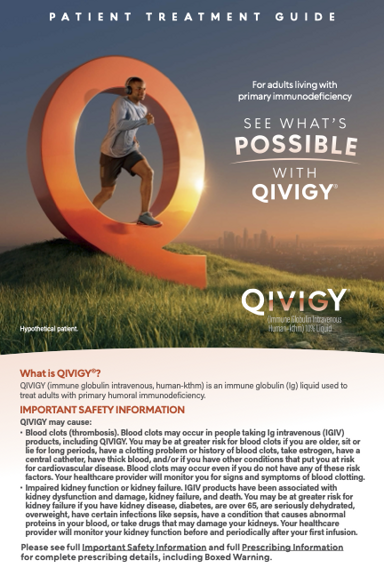
QIVIGY (immune globulin intravenous, human-kthm) is an immune globulin (Ig) liquid used to treat adults with primary humoral immunodeficiency.
QIVIGY may cause:
The most common side effects of QIVIGY were headache, fatigue, infusion-related reaction, positive direct Coombs test result suggesting the immune system is attacking the body's red blood cells, nausea, sinus inflammation, dizziness, and diarrhea. During treatment with QIVIGY, be sure to tell your healthcare provider about any unusual symptoms you experience, as they may indicate a possible side effect.
To report SUSPECTED ADVERSE REACTIONS, contact Kedrion Biopharma Inc. at 1-855-3KDRION (1-855-353-7466) or FDA at 1-800-FDA-1088 or www.fda.gov/medwatch.
Please see full Prescribing Information for complete prescribing details, including Boxed Warning.
Reference: 1. QIVIGY [prescribing information]. Kedrion Biopharma Inc.; 2025.